—
WHERE CO2 COMES FROM (AND WHY IT MATTERS)
IF YOU REMEMBER ONE THING:
Climate change isn’t about CO2 being “bad” — it’s about adding extra ancient carbon
faster than nature can remove it.
When you’re stuck in a traffic jam, it’s easy to think: this must be what’s driving climate
change.
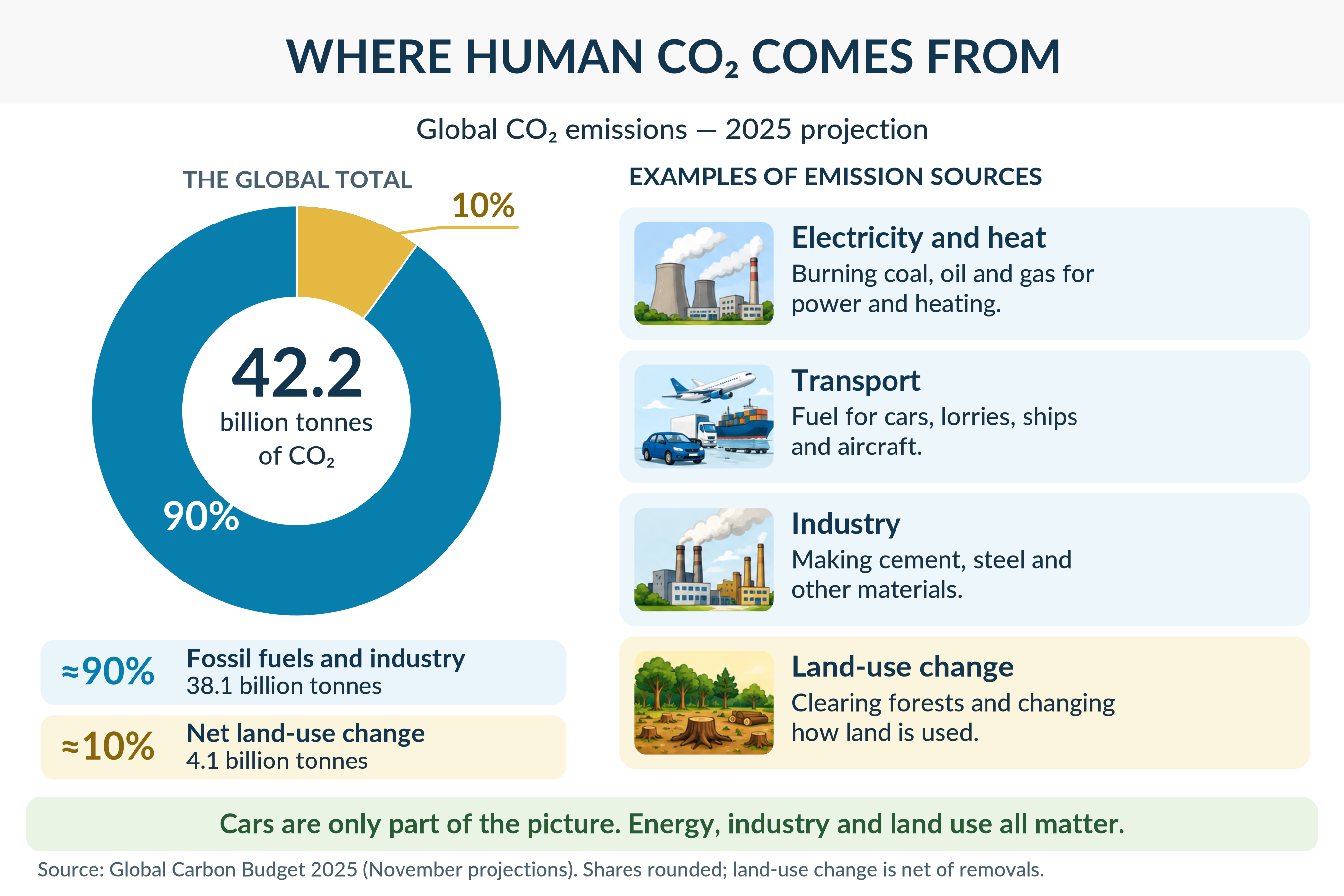
Cars do matter — but this episode shows why they’re only part of a much bigger
carbon story that began hundreds of millions of years ago.
🐾 BELLE’S QUESTION
“Is most CO2 from cars... or something else?”
⸻
🌍 THE BIG IDEA (EXPLAINED SIMPLY)
CO2 is part of nature. Plants take it in, animals breathe it out, and oceans swap it with
the air. That natural carbon cycle leaves a thin greenhouse “blanket” that keeps Earth
warm enough for life.
The problem is extra CO2.
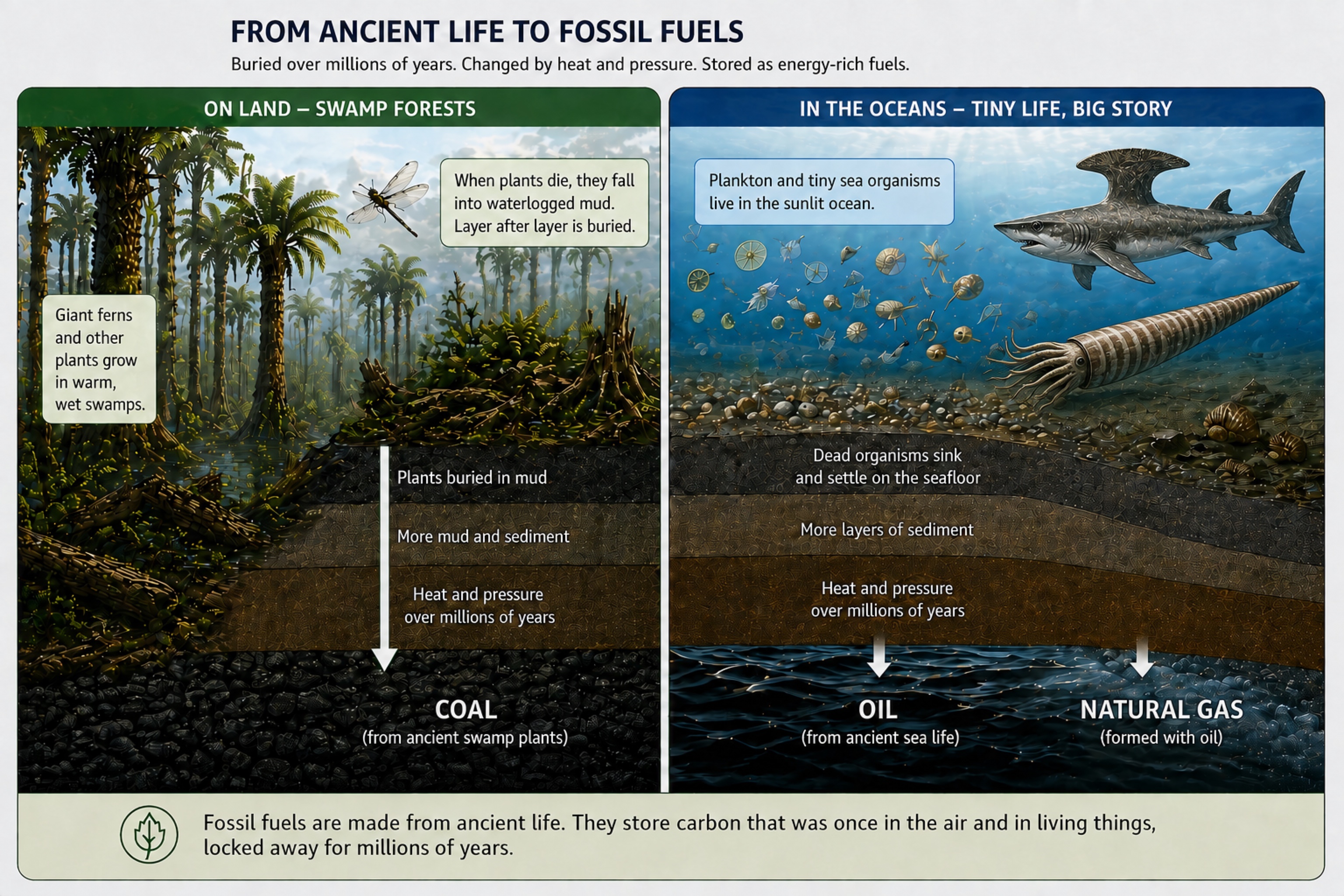
Coal, oil, and gas are made from ancient plants and sea life buried and transformed
over millions of years. When we burn fossil fuels, we unlock that ancient carbon and
release it into the atmosphere very fast — far faster than natural systems can absorb it
again.
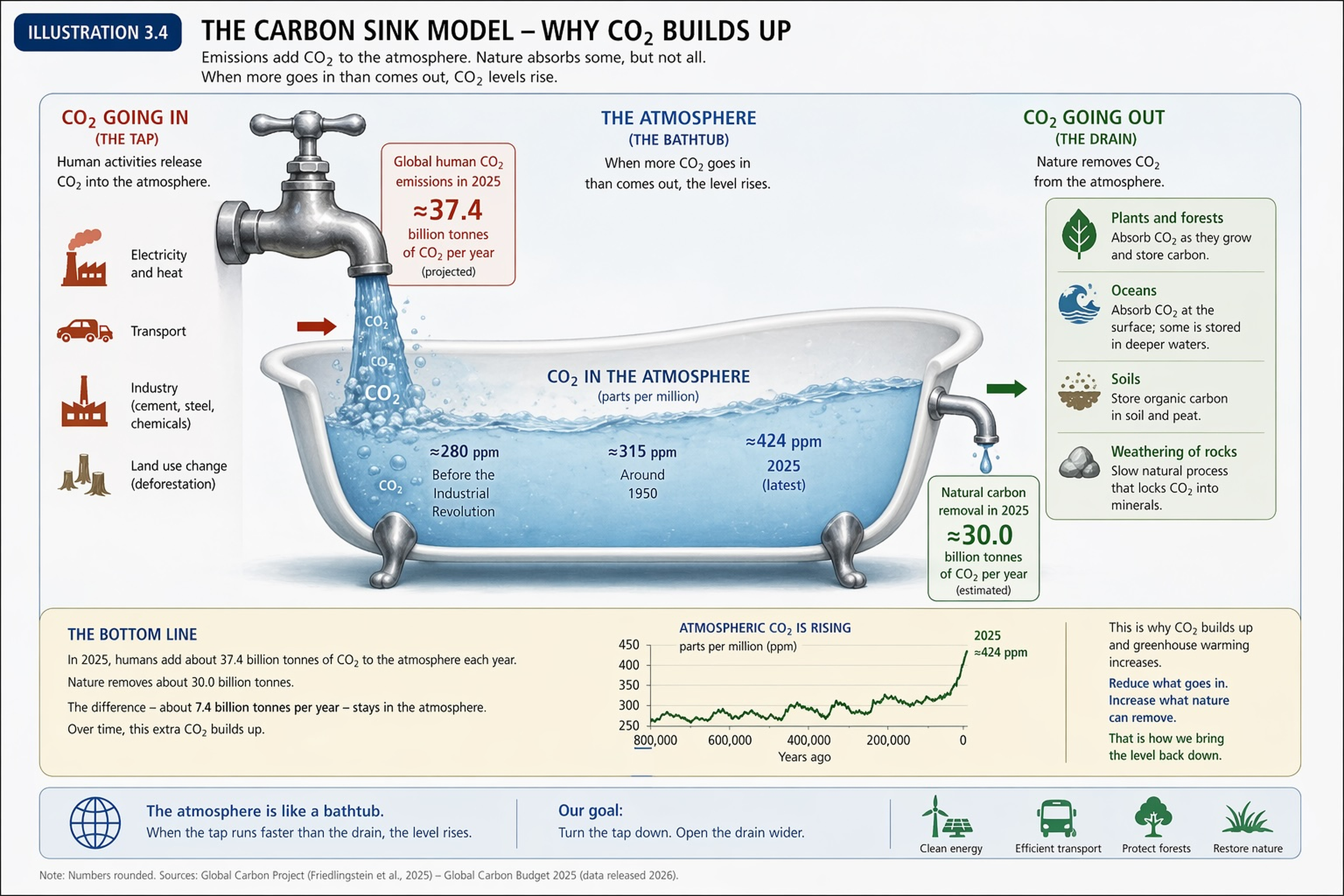
That’s why CO2 builds up, thickening Earth’s heat-trapping blanket.
⸻
🌱 ONE BRIGHT THING
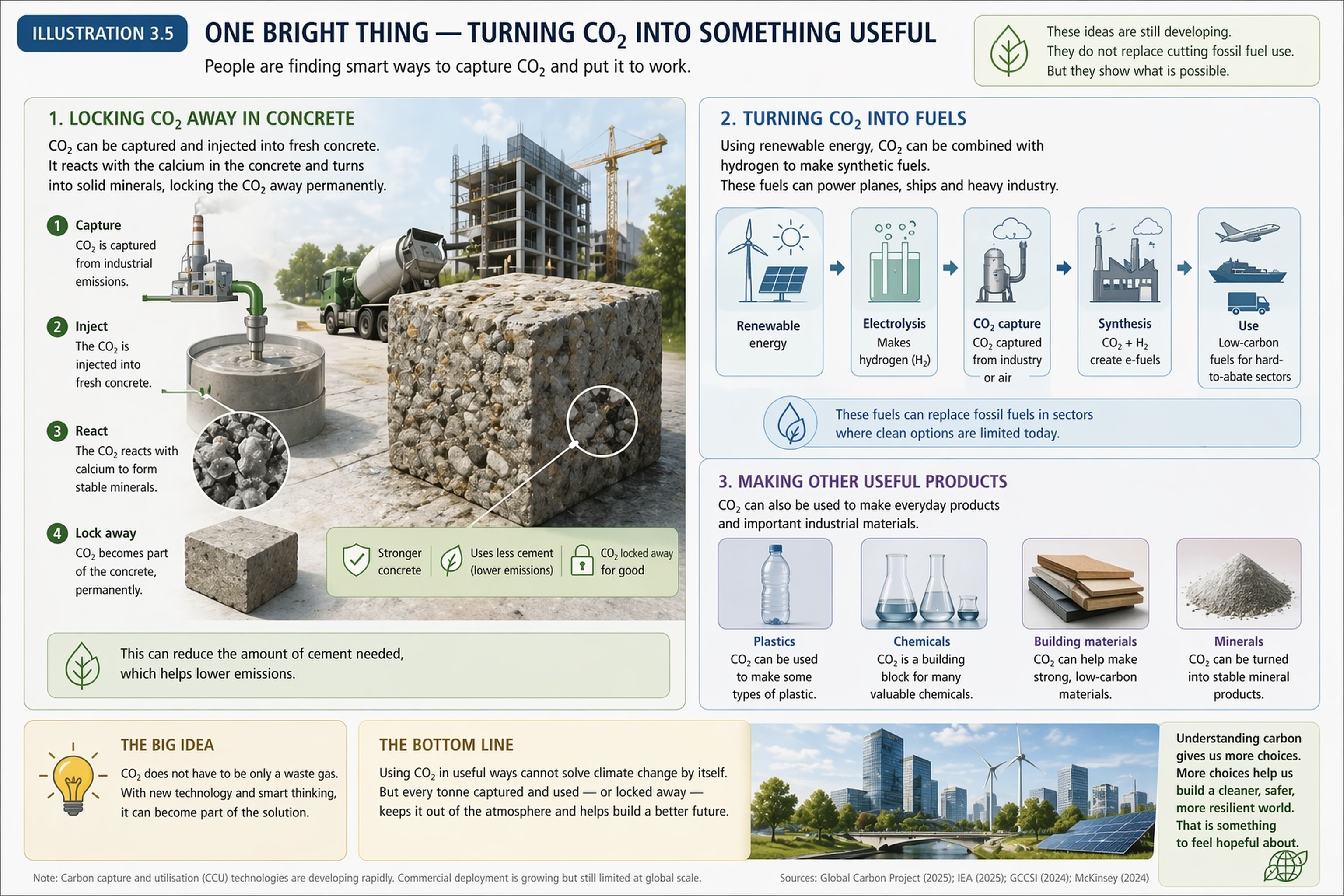
People are starting to treat CO2 as a material, not just a waste gas.
Some companies inject captured CO2 into fresh concrete, where it reacts and turns into
a solid mineral — locking carbon away permanently while reducing the need for some
cement. Others are even using captured CO2 to grow real diamonds in laboratories,
atom by atom.
These ideas don’t replace cutting fossil fuel use — not even close — but they show
carbon can be managed more intelligently.
⸻
🏫 QUICK QUIZ (FOR FAMILIES & CLASSROOMS)
• Fossil fuels are carbon from last year’s plants — or ancient life stored underground?
• True or false: Cars are the only big source of CO2.
• Finish the sentence: Nature absorbs some CO2, but if we turn the tap up too high, the
level still ________.
🔔 FOLLOW & ASK BELLE
If this helped, follow The Climate Classroom on Spotify or Apple Podcasts — so the
next school-run episode arrives automatically.
Got a question for Belle? Send it on Spotify, or at https://www.theclimateclassroom.org
— with “the” at the start.—————
READ MORE / FULL NOTES —————
🎧 IN THIS EPISODE
• CO2 is a natural part of the carbon cycle
• The natural greenhouse blanket keeps Earth from becoming a frozen snowball
• Fossil fuels are ancient carbon from long-dead plants and marine life
• Since the Industrial Revolution, humans have released that carbon extremely quickly
• Major human CO2 sources include:
• Making electricity and heat
• Transport
• Industry (especially cement)
• Deforestation and land clearing
• Why CO2 can build up even though nature absorbs some of what we emit
📚 SOURCES & FURTHER READING (WITH LINKS)
Atmospheric CO2 (the Keeling Curve)
• NOAA — Mauna Loa CO2 record (official long-term measurements):
https://gml.noaa.gov/ccgg/trends/
Climate science assessments
• IPCC — Sixth Assessment Report (AR6), Working Group I:
https://www.ipcc.ch/report/ar6/wg1/
Global temperature records
• World Meteorological Organization (WMO) — State of the Global Climate reports:
https://public.wmo.int/en/our-mandate/climate/wmo-statement-state-of-global-climate
Cement and industry emissions
• International Energy Agency (IEA) — Cement and concrete sector emissions:
https://www.iea.org/energy-system/industry/cement
CO2-mineralised concrete
• Global Cement and Concrete Association — Carbonation and CO2 curing overview:
https://gccassociation.org/concretefuture/climate/
🏫 FOR FAMILIES & CLASSROOMS (DISCUSSION PROMPTS)
• Why does it matter that fossil fuels are millions of years old?
• If nature absorbs CO2, why can levels still rise?
• Which analogy works best for you — a sink with a tap and drain, or more blankets on the bed and why?
Continue in the Core Series: METHANE —THE SUPER-POWERED GREENHOUSE GAS 🐄 💨
Teacher notes
Learning objective: Explain why releasing ancient carbon from fossil fuels adds to atmospheric CO₂ even while natural sinks absorb some carbon.
Keywords: fossil fuel, ancient carbon, carbon cycle, emissions, carbon sink.
Activity: Use the fossil-fuel origin and carbon-sink illustrations to trace carbon from ancient life to underground stores and then into the atmosphere. Draw a sink with a tap and drain: what happens when inflow exceeds outflow?
Quiz answers: Ancient life stored underground; false; rises.
Teaching point: Separate the natural movement of carbon from the additional carbon released by burning fossil fuels. Transport is one source alongside electricity, heating, industry and land-use change. Carbon use in concrete does not replace the need to reduce emissions.