🎧 Belle’s Question
“What is the hidden carbon in things?”
🌍 If you remember one thing...
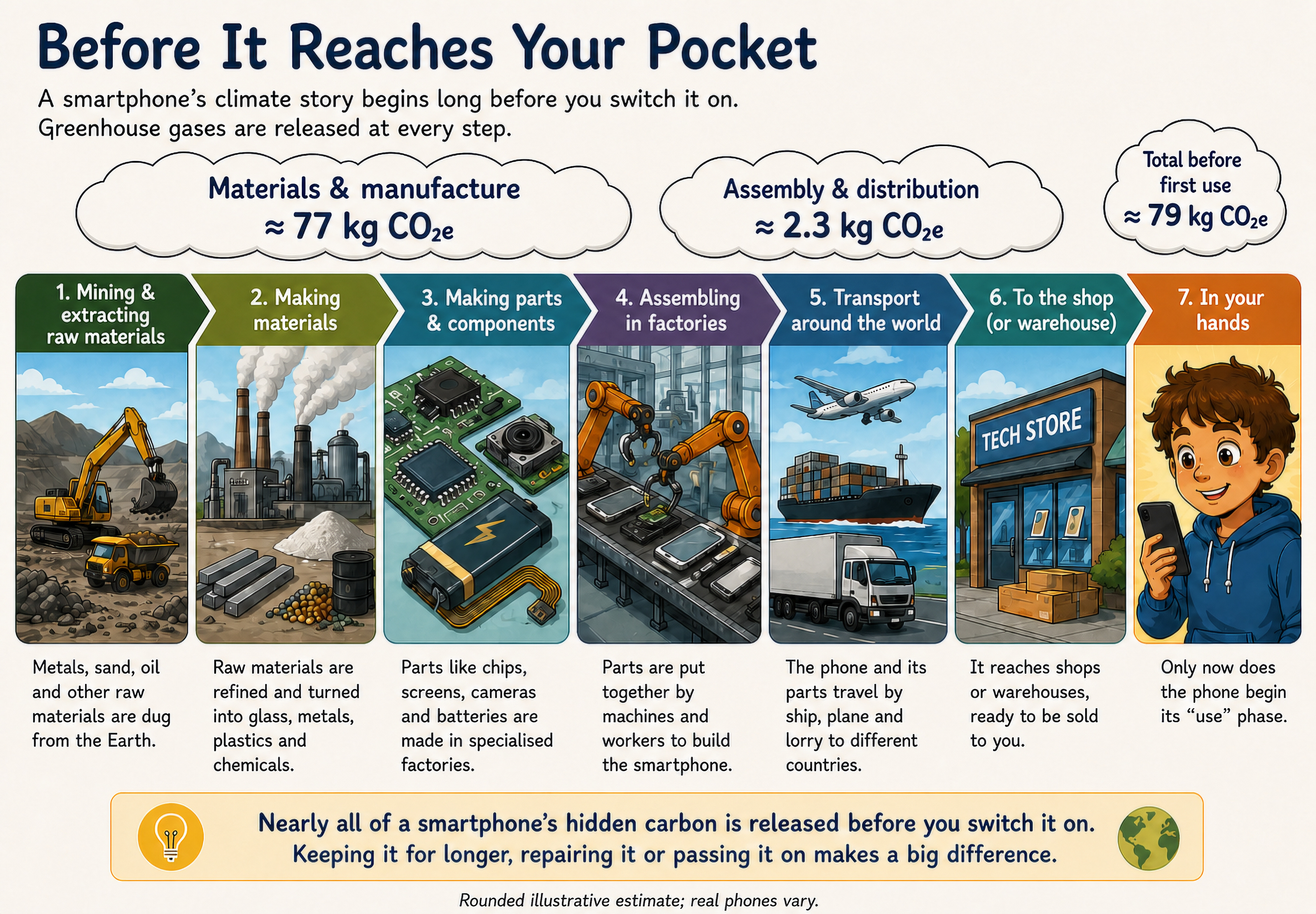
Many products create greenhouse gases before we even use them — through mining, manufacturing, transport, and the materials they are made from.
📦 What we cover
• What “embodied carbon” means
• Why many products create emissions before we even switch them on
• The hidden carbon inside phones, trainers, TVs and cars
• Why cement, steel and plastics matter for climate
• The idea of a circular economy
• Repair, reuse, recycling and refurbished electronics
• Urban mining and recovering valuable metals from old devices
• How scientists and engineers are redesigning products and factories
📏 A simple way to picture scale
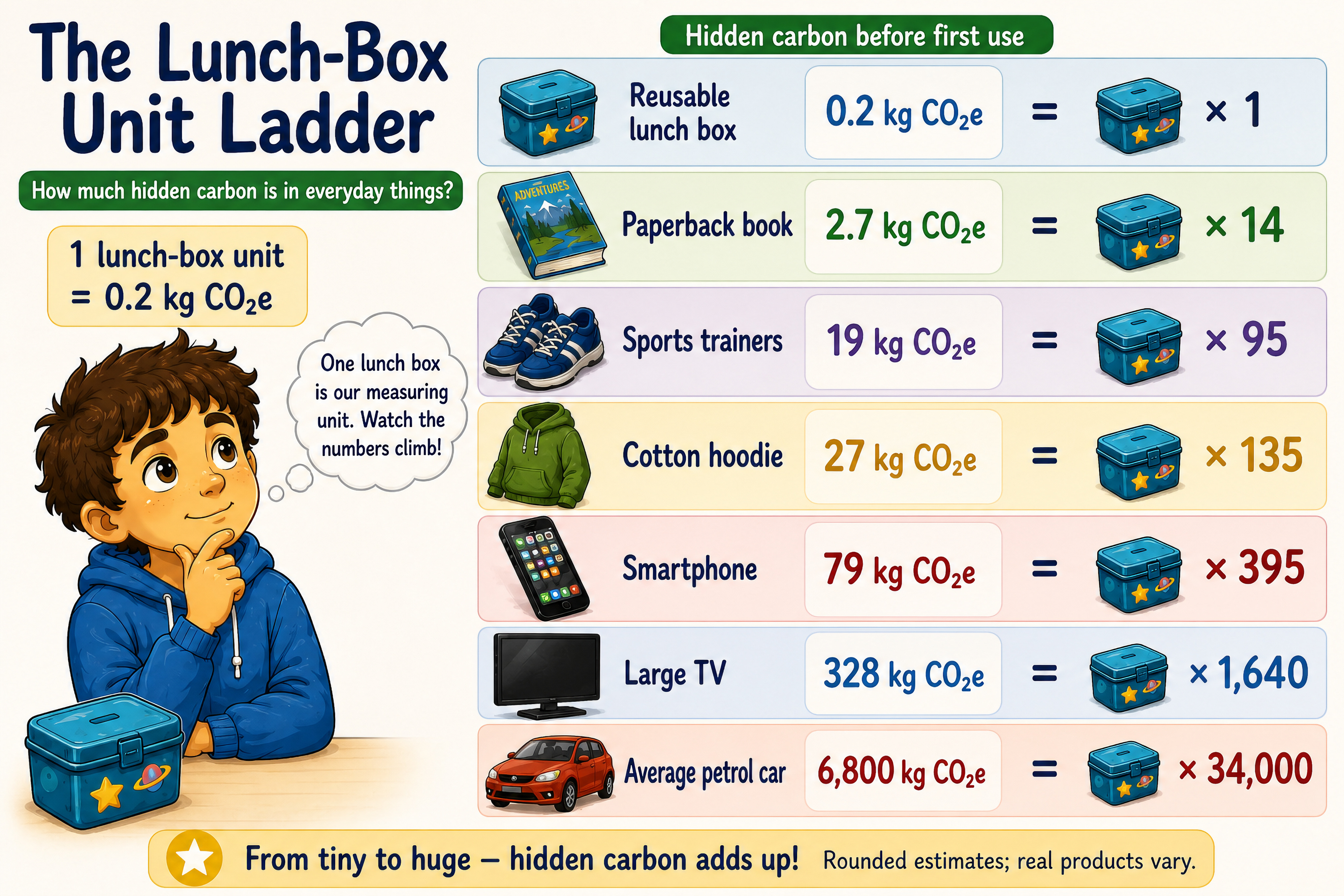
To compare the hidden carbon discussed in this episode, these notes use a simple measuring stick: one lunch-box unit represents 0.2 kg CO2e.
The rounded examples below describe emissions from making an item before its first use; they do not include emissions from using it or disposing of it. Assessment boundaries vary between the source studies, so these are examples of scale, not exact values for every product.
- Reusable lunch box: 0.2 kg CO2e ≈ 1 lunch-box unit
- Paperback book: 2.7 kg CO2e ≈ 14 lunch-box units
- Sports trainers: 19 kg CO2e ≈ 95 lunch-box units
- Cotton hoodie: 27 kg CO2e ≈ 135 lunch-box units
- Smartphone: 79 kg CO2e ≈ 395 lunch-box units
- Large TV: 328 kg CO2e ≈ 1,640 lunch-box units
- Example petrol car: 6,800 kg CO2e ≈ 34,000 lunch-box units
Teacher update: These corrected figures replace the earlier estimates in these show notes. The recording may refer to an older 0.5 kg lunch-box unit; use the 0.2 kg unit and figures above for classroom calculations. The unit is a teaching convention, not a claim that every lunch box has the same footprint.
🏭 Key ideas from this episode
1⃣ Hidden carbon
A large part of a product’s climate footprint often happens before we use it:
• mining raw materials
• manufacturing components
• factory energy use
• transport around the world
Scientists often call this embodied carbon.
2⃣ Materials matter
Different materials create different amounts of emissions.
Cement, steel and plastics are especially important because modern civilisation uses them at enormous scale.
3⃣ Climate change is also a materials challenge
Cement, steel and plastics matter because the world uses them in enormous quantities. Making these materials can release large amounts of greenhouse gases.
Climate change is therefore also a materials challenge: how can we make useful products with fewer emissions, keep them in use for longer, and recover their materials safely?
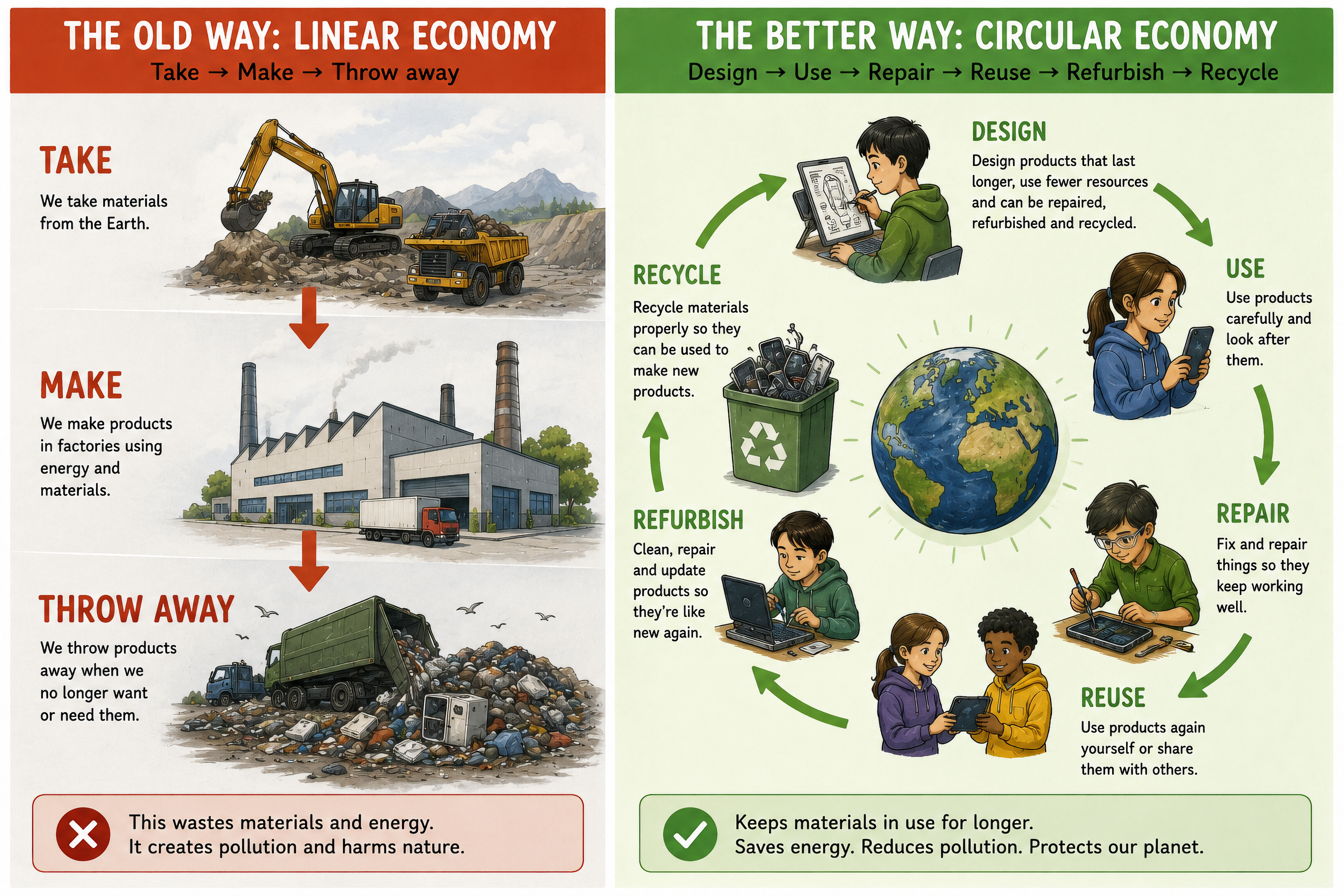
4⃣ Circular economy
For many years economies mostly worked in a straight line:
take → make → throw away.
A circular economy tries to keep materials useful for longer through:
• repair
• reuse
• refurbishment
• recycling
• better product design
5⃣ Urban mining
Old electronics contain valuable materials such as gold, copper and cobalt.
Recovering these materials from old devices is sometimes called urban mining.
There is actually more gold in a tonne of old mobile phones than in a tonne of gold ore dug out of the ground.
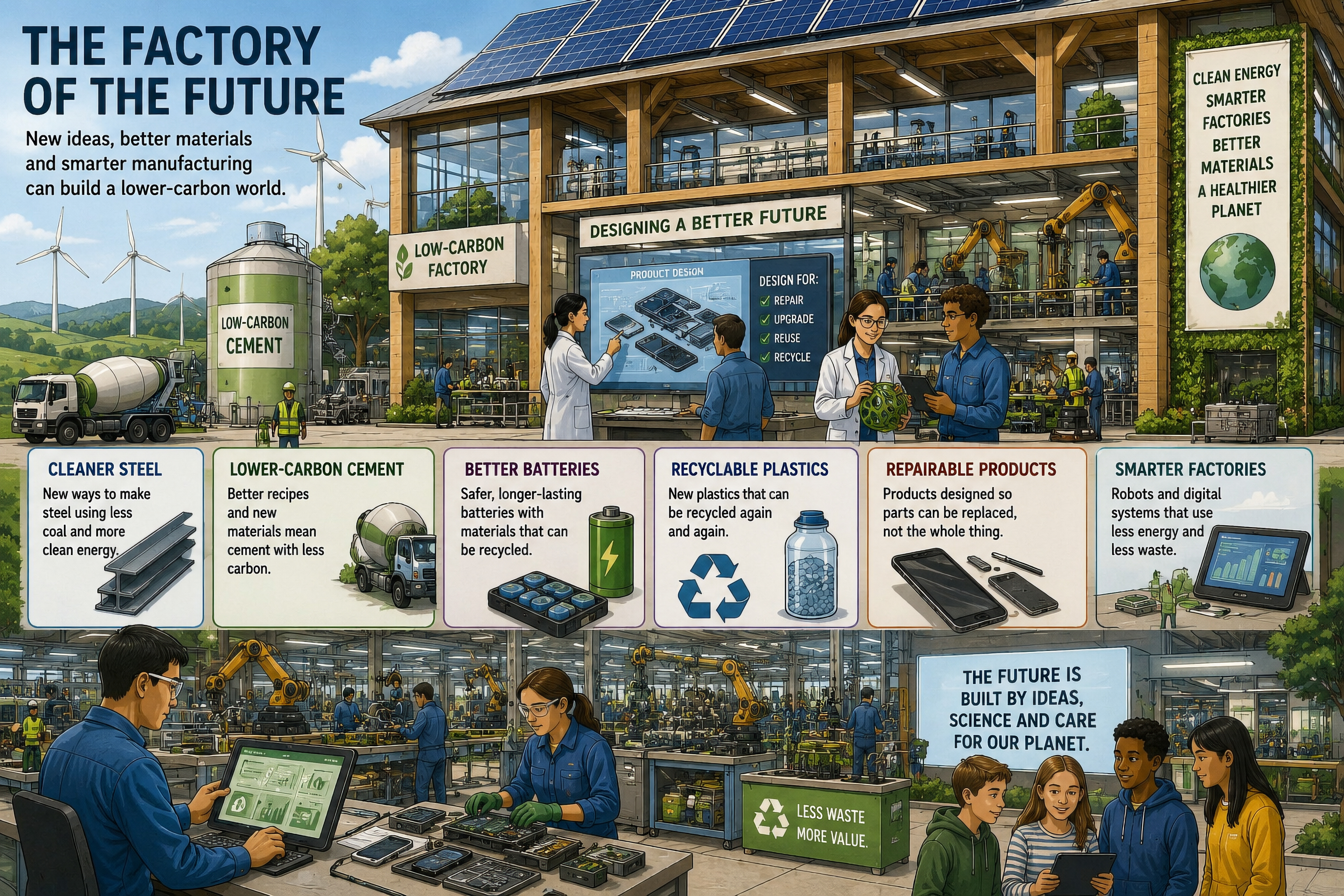
✨ One Bright Thing — The Factory of the Future
Scientists and engineers are redesigning how products are made.
Examples include:
• lower-carbon cement
• cleaner steel production
• recyclable batteries
• plastics made from plants or waste oils
• advanced recycling systems
• factories powered by renewable electricity
• 3D printing systems that waste less material
Some companies are also designing products that are easier to repair, upgrade and recycle.
Refurbished phones are one example. A repaired and reused phone can often do almost the same job as a new one — with a smaller climate footprint.
📚 Sources & further reading
Sources for the product examples:
- ADEME Impact CO2: smartphone, television, cotton sweatshirt and sports shoes. The figures above are rounded manufacturing/pre-use estimates.
- Wells et al. (2012), Carbon Footprint Assessment of a Paperback Book: a specific book's cradle-to-gate estimate, rounded to 2.7 kg CO2e.
- Yadav et al. (2024), Life cycle assessment of reusable plastic food packaging: context for the lunch-box order of magnitude. The fixed 0.2 kg unit is a classroom convention.
- ADEME Base Empreinte, road-vehicle manufacturing factors: the example assumes a 1,500 kg petrol car and 4.5 kg CO2e per kg of vehicle, giving 6,750 kg CO2e, rounded to 6,800.
• Apple Environmental Reports — product carbon footprints and recycled materials
• International Energy Agency (IEA) — Industry and materials emissions
• UNEP — Global Resources Outlook
• Our World in Data — CO2 and greenhouse gas emissions
• Ellen MacArthur Foundation — Circular economy explained
• International Aluminium Institute
• Adidas x Allbirds Futurecraft Footprint project
🧑🏫 Teacher Notes
This episode introduces the idea that climate change is not only about electricity, cars and aeroplanes. It is also about materials and manufacturing.
Children often assume that the climate impact of a product mainly comes from using it. This episode explains that many emissions happen before the product even reaches us.
The “lunch-box unit” is designed as a simple classroom tool for comparing the hidden carbon of different objects.
Useful discussion questions:
• Why might a smartphone create emissions before it is switched on?
• Why do cement and steel matter so much for climate?
• What makes a product difficult or easy to repair?
• What is the difference between a linear economy and a circular economy?
• Why might refurbished electronics become more common in future?
🎧 Have a question you’d like Belle to ask?
Send it in at theclimateclassroom.org