EPISODE 9 – The Rising Sea
🎧 Episode 9 – Show Notes
🌊 Episode title: The Rising Sea -Warming Oceans & Melting Ice
🐾 Belle’s Question: Why is sea level rising even where there’s no ice nearby?
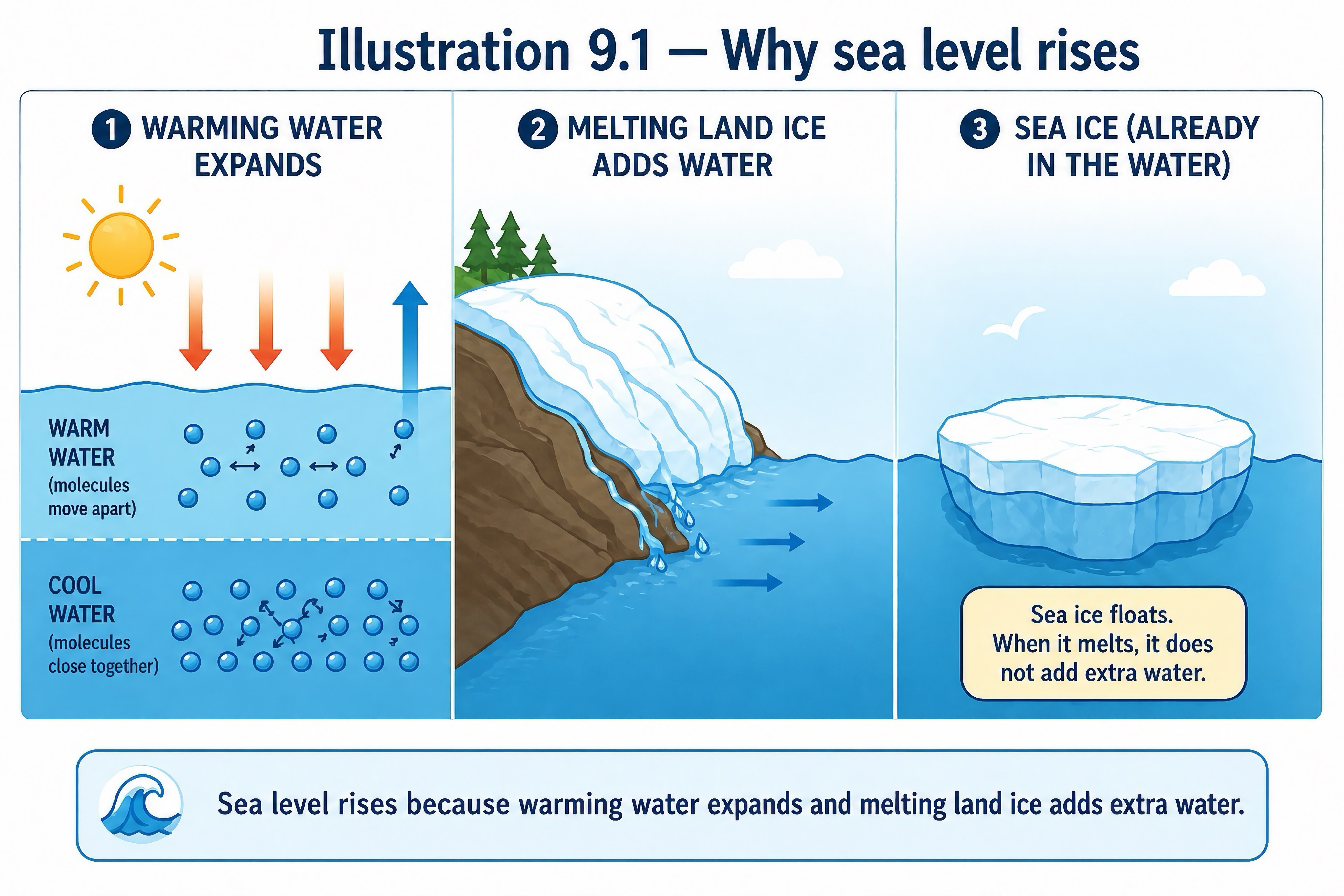
💡 If you remember one thing: Sea level rises because warmer ocean water takes up more space, and melting land ice adds more water to the sea.
🧭 What we cover:
- Sea level rises in two main ways: warmer seawater expands, and melting land ice adds water to the ocean.
- The biggest sea-level story is about glaciers and ice sheets on land, not floating sea ice.
- Sea level rise is measured carefully over time using tide gauges and satellites.
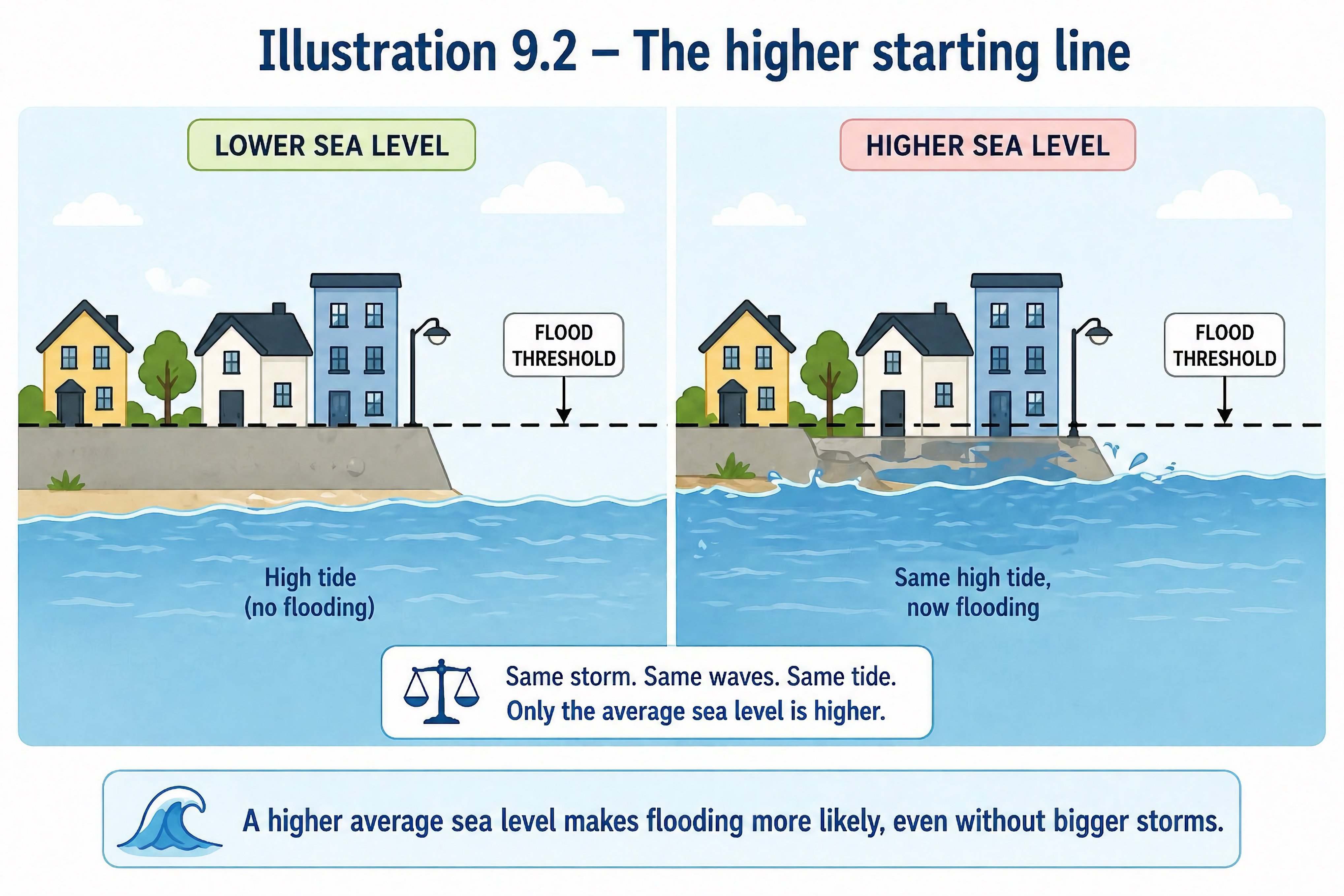
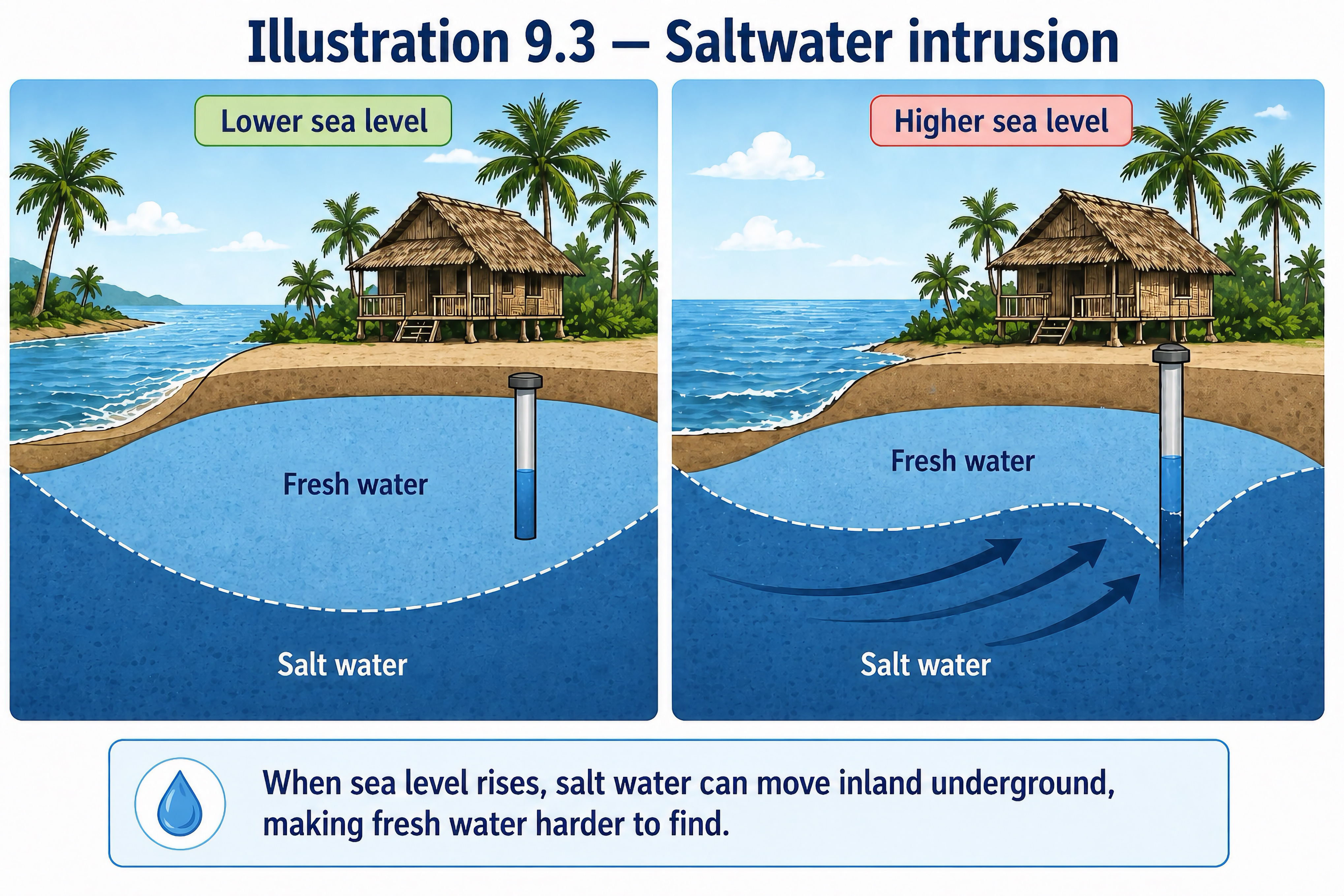
- A higher average sea level makes coastal flooding and erosion more likely. Salt water can also get into freshwater supplies, soils, wetlands, and farmland near coasts.
- Low-lying island states such as Kiribati show why sea level rise is a serious human problem, not just a map problem.
- Sea level rise has a “long memory”: even after warming stops increasing, the sea can keep rising for a long time.
✨ One Bright Thing:
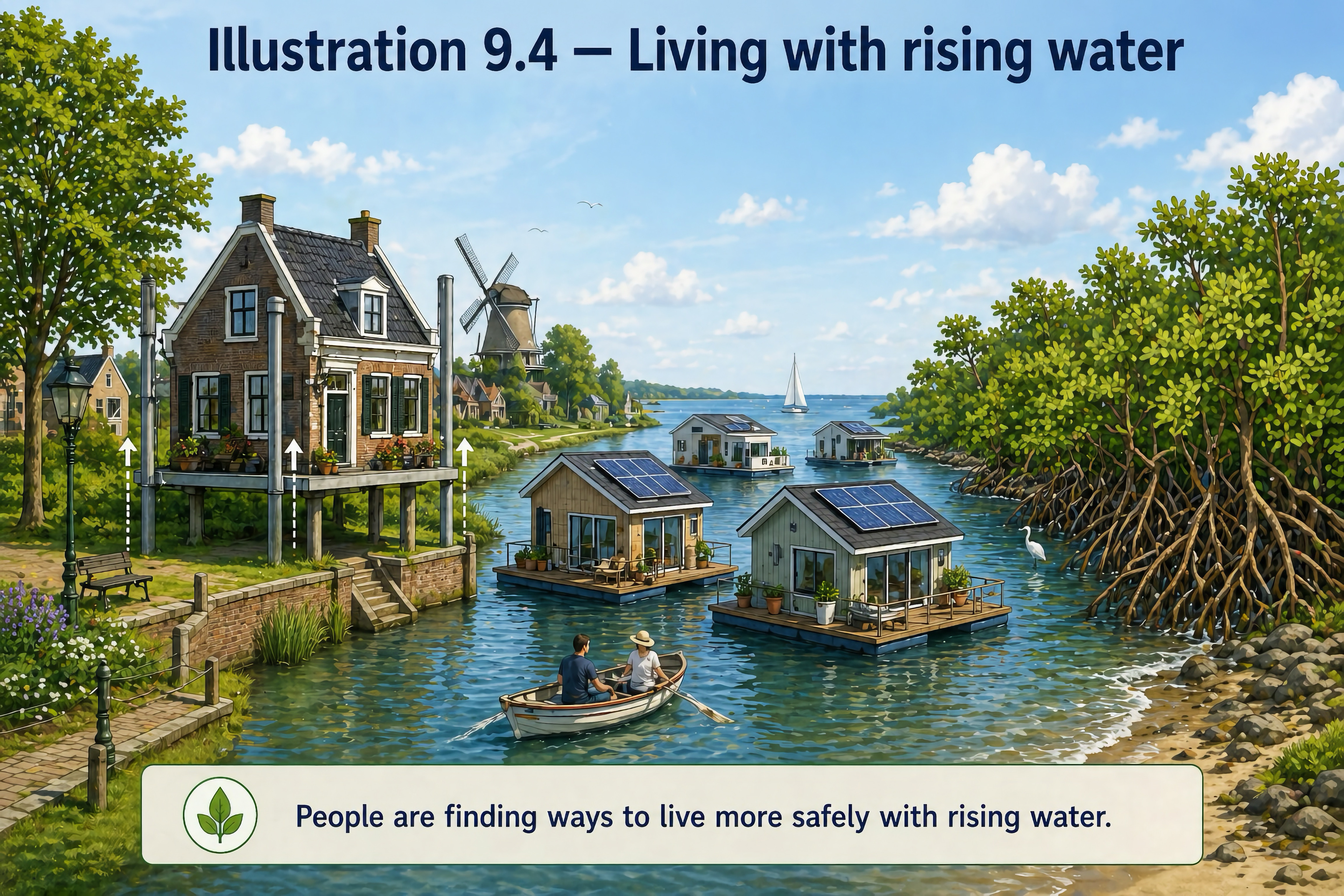
In Maasbommel in the Netherlands, amphibious houses were developed as part of a flood-resilient approach. They are anchored to the ground but can float upward during floods, showing that adaptation can mean learning to live more safely with water rather than only trying to keep it out.
In Tuvalu, about 8 hectares of new raised land have been created under the Tuvalu Coastal Adaptation Project. That land was designed to stay above projected sea levels beyond 2100 — a striking example of climate adaptation in a very small, low-lying island country.
🔢 Key numbers mentioned:
Global mean sea level in 2024 was the highest since satellite records began in 1993. Since 1993, global sea level has risen by about 10 centimetres. The sea is now rising more than twice as fast as it was in the 1990s. Tuvalu has only about 25 square kilometres of land in total, and the new raised land there covers about 8 hectares — around ten football pitches.
Since 1993, global sea level has risen by about 10 centimetres — about the height of a coffee mug. The rate of sea-level rise in 2015–2024 was about 4.7 mm per year, compared with about 2.1 mm per year in 1993–2002.
Kiribati’s islands are very low-lying, with many only a little above sea level.
Sea-level rise this century is expected to be measured in tens of centimetres globally, with how much depending strongly on future emissions.
👩🏫 Teacher Notes:
This episode explains sea-level rise as a physical response to warming with two main causes: thermal expansion of seawater and the addition of water from melting land ice. It reinforces the distinction between land ice and floating sea ice, introduces measurement through tide gauges and satellites, and shows why sea-level rise matters through flooding, erosion, salinisation, and risks to low-lying islands such as Kiribati. The episode also introduces the idea that sea-level rise has a “long memory”: oceans and ice sheets respond slowly, so sea level can continue rising for a long time even after warming has levelled off.
📌 Teacher discussion prompts:
Why does a small rise in average sea level make flooding much more likely?
Why are places like Kiribati especially vulnerable to sea-level rise?
What kinds of engineering or design might help communities adapt to higher seas?
📚 Sources & further reading
NASA Sea Level Change Team, overview of global sea level and thermal expansion, https://sealevel.nasa.gov/understanding-sea-level/global-sea-level/overview/
NASA Sea Level Change Team, thermal expansion, https://sealevel.nasa.gov/understanding-sea-level/global-sea-level/thermal-expansion/
WMO, State of the Global Climate 2024, https://wmo.int/sites/default/files/2025-03/WMO-1368-2024_en.pdf
IPCC Special Report on the Ocean and Cryosphere, sea level rise and low-lying islands, coasts and communities, https://www.ipcc.ch/srocc/chapter/chapter-4-sea-level-rise-and-implications-for-low-lying-islands-coasts-and-communities/
World Bank Climate Knowledge Portal, Kiribati country profile, https://climateknowledgeportal.worldbank.org/sites/default/files/country-profiles/15816-WB_Kiribati%20Country%20Profile-WEB.pdf
Schoonschip Amsterdam – https://schoonschipamsterdam.org/?utm_campaign=floating-neighborhoods-the-future-of-coastal-real-estate&utm_medium=referral&utm_source=www.floatingeconomy.com#site_header